
Chat Widget#
Powered by Squirro Chat, the Chat widget extends the capabilities of your dashboards, allowing users to ask questions and receive detailed answers within the context of a specific dataset.
Getting Started#
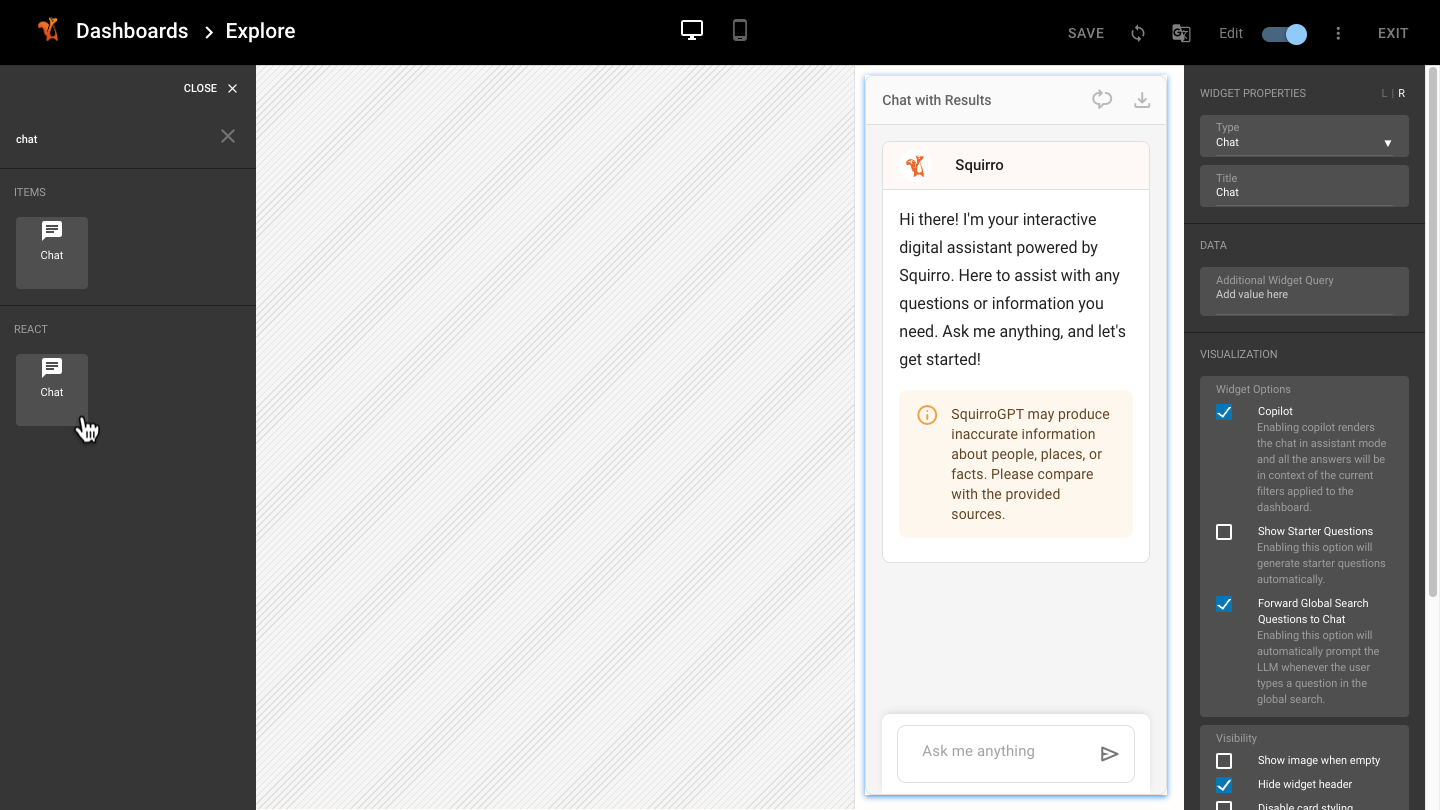
When designing custom dashboards, select a layer in one of the sections, then place the Chat widget. Turn on the Copilot setting to switch the chat to assistant mode, to receive answers in the context of the currently applied filters. Turn on the Forward Global Search Questions to Chat setting to automatically prompt Squirro Chat every time the user types a question in the global search. The Show Starter Questions option automatically generates relevant questions to help users begin conversations. For detailed information about configuring and customizing starter questions, see the Starter Questions page.
Applied Context#
When you apply filters to a dashboard and ask a question using Copilot mode, those filters travel with the conversation. If you open that conversation in the Chat dashboard, an Applied Context chip appears in the search field. That chip indicates that responses are scoped to the filters that were active when you started the conversation. Hover over the chip to view the full filter details.
The chip provides two options:
Copy the filter details to your clipboard using the icon.
Remove the applied context using the icon.
Disclaimer Text#
The Chat widget shows a short disclaimer below the chat input field. Use that disclaimer to tell your users that they are interacting with an AI assistant and that answers can contain mistakes.
Three settings control the disclaimer. To find them, open the dashboard editor, select the Chat widget, then locate the Widget Options group in the Visualization section of the widget properties panel.
Disclaimer text
The text shown below the chat input field. Squirro provides a default text, which you can replace with your own wording.
Show disclaimer text in normal chat mode
Shows the disclaimer when Squirro Chat runs inside Squirro, which includes the Chat widget on a dashboard, the Chat dashboard, and Chat with Document. Turned on by default.
Show disclaimer text in embed mode
Shows the disclaimer when Squirro Chat runs as the embedded Digital Assistant on your own website or application. Turned on by default.
All three settings apply to the Chat widget you are editing. Configure them on each widget where you want the disclaimer to appear, and repeat the configuration on the widget used by the dashboard you embed.
Clearing the Disclaimer text field restores the default text. To hide the disclaimer, turn off the setting for the mode where you do not want it to appear.
Important
Squirro turns both disclaimer settings on by default and recommends leaving them on for every Chat widget you deploy. If you replace the default wording, keep a statement that the user is interacting with an AI assistant.
Which Setting Applies#
Squirro Chat applies one of the two settings at a time rather than both together, and selects between them by mode.
Chat runs in embed mode when the page URL carries the
assistantquery parameter with a value. That is how the embedded Digital Assistant is loaded.Chat runs in normal chat mode in every other case, which covers the Chat widget on a dashboard, the Chat dashboard, and Chat with Document.
Leave both settings turned on, so that the disclaimer appears whichever mode your users reach. If a disclaimer does not appear in your own embed, check that the embedding URL carries the assistant query parameter with a value, because without it the widget uses the normal chat mode setting instead.
Formatting and Translation#
The Disclaimer text field supports Markdown, so you can emphasize part of the sentence or link to your own AI policy. For example:
Answers are AI generated. See the [AI policy](https://example.com/ai-policy).
The field also supports project translations, so you can show the disclaimer in the language selected by the user. Reference a translation key in the field in the same way as any other dashboard text. For more information, see the Translating Dashboards with Project Translations page.
AI Transparency and the EU AI Act#
The EU AI Act, Regulation (EU) 2024/1689, sets transparency requirements for AI systems that interact directly with people. Those requirements apply from 2 August 2026.
The Act allocates duties between different actors, principally the provider of an AI system and the organization that deploys it. Squirro is the provider of Squirro Chat under the EU AI Act when it is used inside the Squirro platform, and ships the disclaimer for that reason. Squirro ships this notice turned on by default in the embedded Digital Assistant as well, and does not treat embedding the assistant as moving that responsibility.
How the Act applies to your own organization depends on how you deploy the assistant, including whether you present it under your own name or brand, and whether you modify it. Squirro cannot make that determination on your behalf.
What Squirro provides for AI transparency in Chat:
A disclaimer below the chat input field, shown by default in both normal chat mode and embed mode.
Control over the disclaimer wording, so you can adapt it to your users.
Markdown formatting and project translations, so you can present it in every language your users work in.
Squirro recommends the following wording, which states both that the user is interacting with an AI assistant and that the answers can be wrong:
You are chatting with an AI assistant. Answers are AI generated, so mistakes can happen. Check important information.
Review the disclaimer text configured on your own widgets. If you replaced the Squirro default with your own wording, check that your wording states the user is interacting with an AI assistant. A notice that only warns about accuracy does not do that.
Practical steps that support AI transparency in your deployment:
Keep the disclaimer turned on for every Chat widget and on every surface your users reach.
State in the disclaimer text that the user is interacting with an AI assistant.
Provide the disclaimer in every language your users work in, using project translations.
Review the wording you publish, and your own obligations, with your legal counsel.
For the Squirro position on AI processing, security, and compliance, see the Security page, which links to the Squirro Trust Center website.
Warning
This page describes the disclaimer settings that Squirro provides. It is not legal advice, and it does not determine which obligations under the EU AI Act apply to your organization. Assess your own obligations, and the wording you publish, with your own legal counsel.
Usage#
You can access the Chat widget in various ways.
Chat with Results#
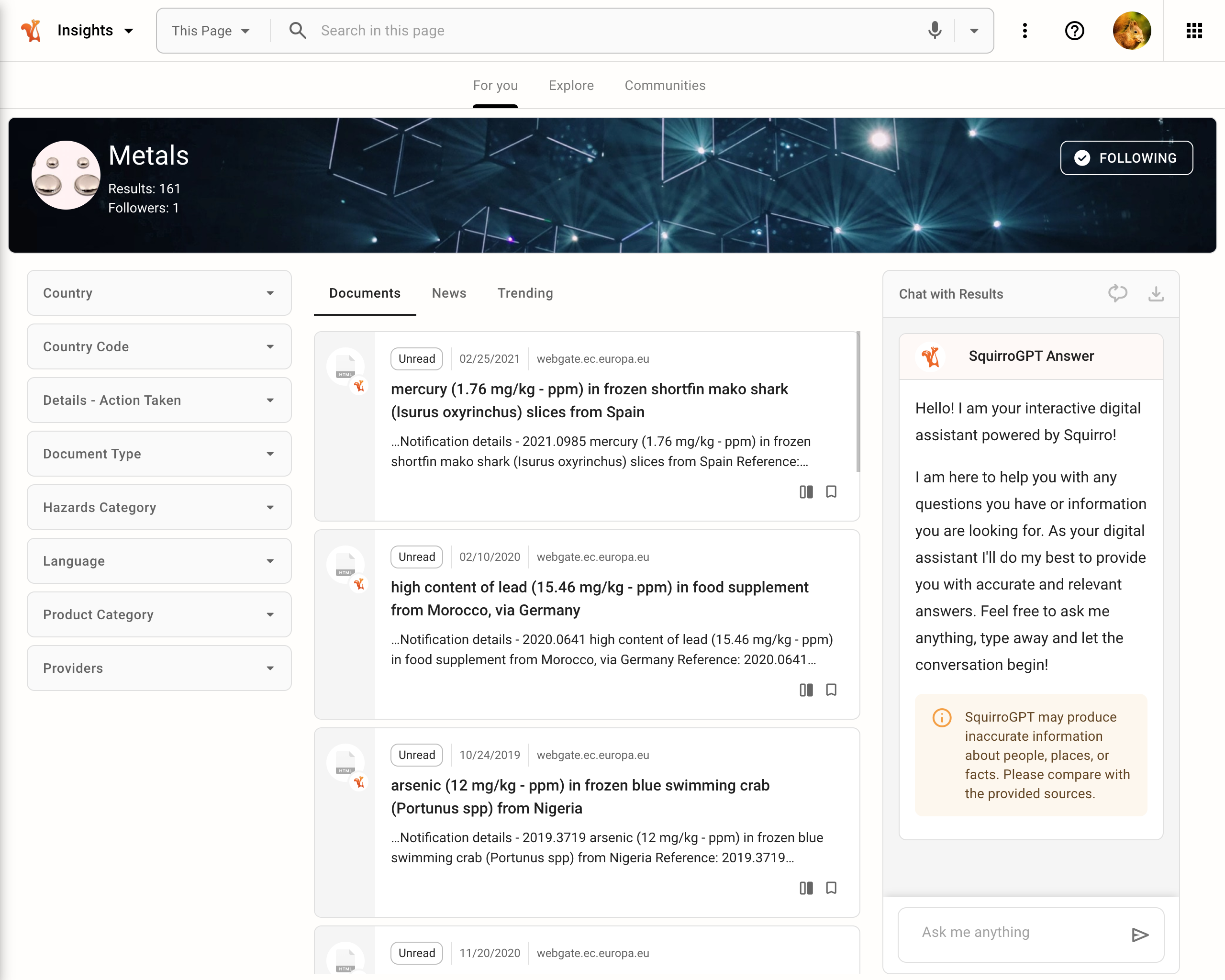
Adding the Chat widget to the Community 360 dashboard offers a powerful way for users to ask questions about a specific topic. When you modify the applied filters, Squirro Chat detects automatically when the context of a discussion has changed and informs you that future responses might be affected, letting you choose between starting a new chat or continuing.
Chat with Document#
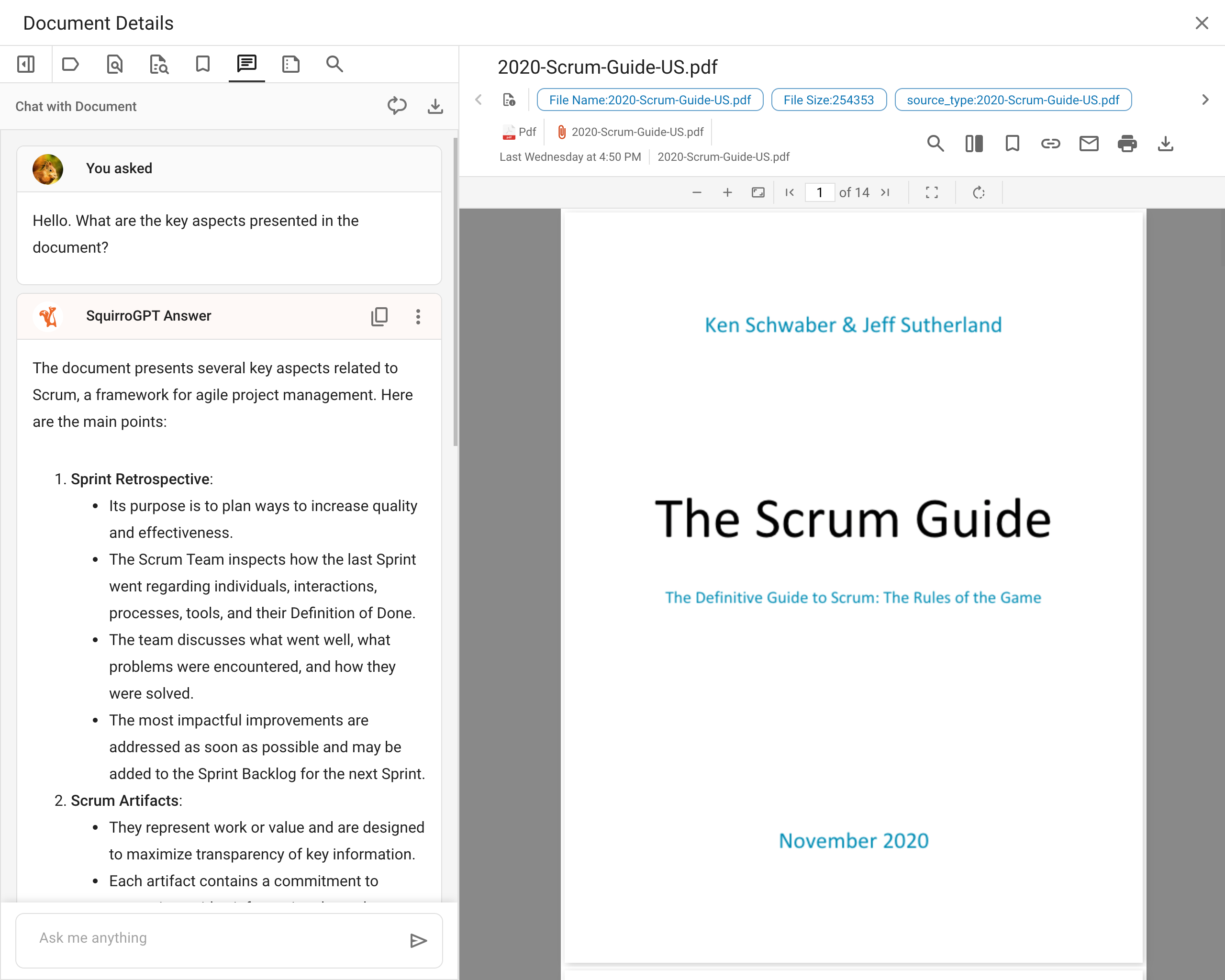
The Item Detail widget contains by default the chat functionality. See the Item Detail Widget page for more information.
Chat dashboard#
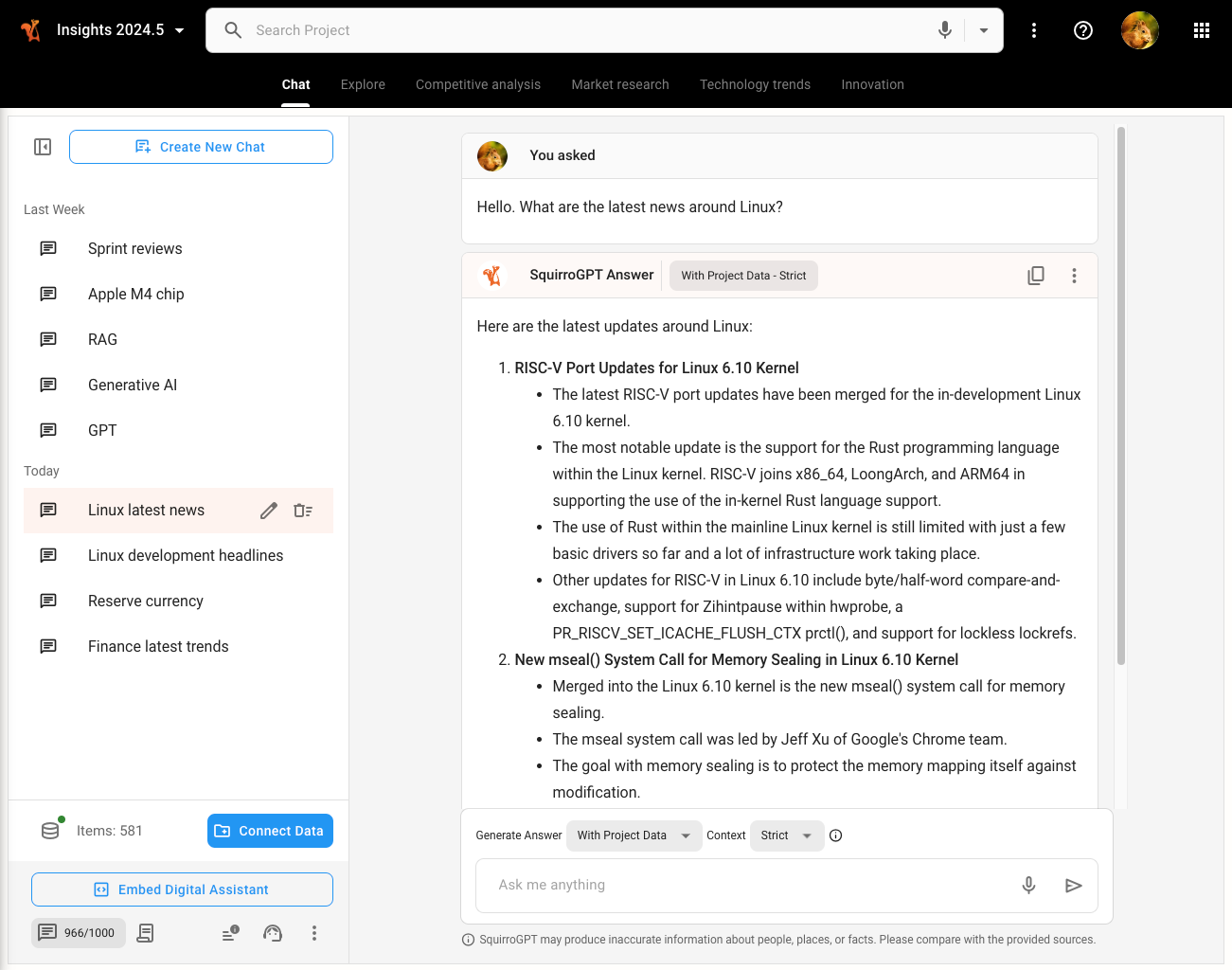
Welcome your users with a modern data analysis experience, use the Chat widget as the project homepage by configuring it in standalone mode inside a dashboard.